R. Dr. Francisco Sá Carneiro
Zona Industrial de Bouro - Letra C
4740-010 Esposende, Portugal

The Invisible Ingredient That Makes Solar Cleaning Work
Why wetting agents are quietly becoming essential in any serious O&M programme
Ask most solar O&M teams what they use to clean panels and you will hear the same answer: water and brushes. That is true — but it is only part of the story. What you add to that water has a bigger impact on cleaning results than most people realise. One additive in particular is gaining traction among professional cleaning crews across every method — waterfed poles, rotary brushes, autonomous robots, and tractor-mounted systems alike: the wetting agent. In this article, we’ll explain how it works, why it’s important even for those who use pure water, and what to consider when choosing one.
How Wetting Agents Work
A wetting agent is a surfactant — a molecule with one water-attracting end and one water-repelling end. When dissolved in water, these molecules position themselves at the water-surface interface and dramatically lower surface tension, causing water to spread into a thin, uniform film rather than beading into droplets.
Beading water is the enemy of effective panel cleaning: it fails to penetrate under dust and grime, leaves circular residue marks on drying, and forces more brush passes to achieve the same coverage.
Chemitek Solar’s Solar Wash Protect (SWP), while not a conventional wetting agent by classification, is widely used as one in photovoltaic cleaning applications due to its ability to significantly reduce surface tension at working dilution. Its formulation enables water to spread more uniformly across the panel surface and penetrate beneath adhered contaminants, delivering the practical benefits associated with dedicated wetting agents. In practice, SWP functions as a wetting agent within the system, even though its formulation extends beyond that single role.
Independent lab testing (pendant drop method, Optical Tensiometer Theta Basic) confirms the effect: plain water measures 81.74 mN/m surface tension. SWP at a 1:500 dilution reduces that to 51.43 mN/m — a 37% reduction — without producing foam or requiring a rinse step.
The Practical Difference — Including for Pure Water Users
The improvement is visible in the field regardless of the water source. Without a wetting agent, water beads, brushes work harder, rinsing is less thorough, and panels resoil faster due to uneven residue on the surface. With a wetting agent, water sheets uniformly, soiling lifts more easily, rinsing is cleaner, and panels stay cleaner for longer — directly reducing labour hours per clean and improving post-clean transmittance.
This is where many pure water users are surprised. Reverse osmosis and deionised water (TDS below 10 ppm) eliminate mineral spotting by removing dissolved salts — but purification does not change the hydrogen bonding between water molecules that governs surface tension. Pure water at 0 ppm TDS has essentially the same surface tension as tap water: approximately 72–73 mN/m. Removing minerals solves the spotting problem; it does nothing to the beading problem.
Adding SWP at 1:500 to a pure water system combines the best of both worlds: no mineral spotting, no surfactant residue, and dramatically improved wetting. The result is a cleaning setup that is greater than the sum of its parts.
Two More Benefits: Surface Protection and Water Savings
A wetting agent that ensures a continuous film of water across the glass also acts as a lubricating layer between bristles and panel. Without it, brushes scrub against a poorly wetted surface, contributing to micro-abrasion of the anti-reflective coating over time — a gradual degradation that is easy to overlook until transmittance readings start declining. With a wetting agent, brushes glide, achieving the same cleaning result with less mechanical aggression. This cumulative benefit matters most on sites with weekly or higher-frequency cleaning schedules, where the long-term effect on panel surfaces is greatest.
Better wetting also means less water per clean. Improved surface coverage requires less volume to achieve the same result, and more effective rinsing reduces the number of passes needed. On utility-scale sites cleaning thousands of panels per cycle — typically in arid regions where water logistics are already a challenge — even modest per-panel savings add up quickly.
Choosing the Right Product and Dilution
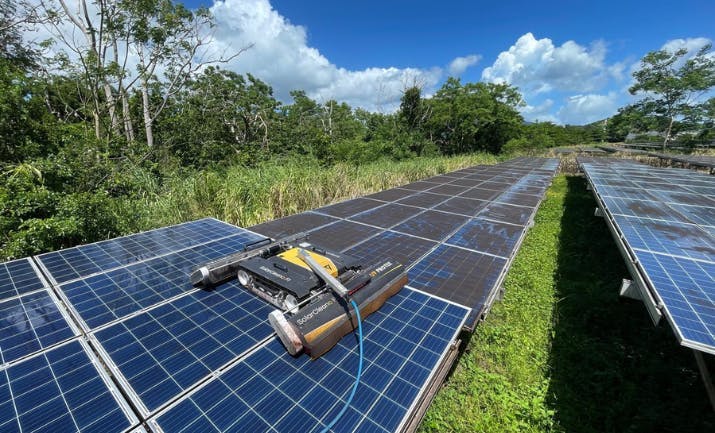
Wetting agents work across all cleaning methods — waterfed poles (e.g. Tucker Solar Boost), rotary brushes (e.g. Solatecs), robots (e.g. Solarcleano F1), and tractor brushes (e.g. Sunbrush) — but not all formulations are suitable for solar use. The critical requirement is zero foam. Foaming leaves excess surfactant residue on the panel surface, causing streaks and stains after drying and creating a film that accelerates resoiling. Any product must be validated at actual working dilution, not just in laboratory conditions.
This is why dilution matters as much as formulation. SWP at 1:500 hits the operational sweet spot: meaningful surface tension reduction (51.43 mN/m), zero foam, and no dedicated rinsing step required — compatible with every cleaning system. At higher concentrations (1:50, 1:150, 1:300) the surface tension effect is stronger, but foam and residue become field concerns. At 1:500, the chemistry works with your operation rather than adding to it. Add it to your cleaning water, clean as normal, and the wetting agent does its work without changing your workflow.
The Bottom Line
Wetting agents are one of the simplest upgrades available to a solar cleaning operation. They require no new equipment, no change to cleaning schedules, and no additional training. Yet the return is tangible across every metric that matters to O&M teams: cleaning quality, labour efficiency, water consumption, panel longevity, and energy yield.
We believe it is important to note that whether you are running a single-site manual crew or managing a multi-site robotic programme, the question is not really whether a wetting agent is worth using. It is whether you are using the right one — correctly formulated, validated at working dilution, and proven not to leave residue behind. That is the bar any serious product in this category needs to clear.