R. Dr. Francisco Sá Carneiro
Zona Industrial de Bouro - Letra C
4740-010 Esposende, Portugal

When Cleaning Alone Is Not Enough: Enhancing PV Performance with Anti-Soiling Coatings
Soiling is one of the most persistent—and underestimated—sources of energy loss in photovoltaic (PV) systems. Whether it’s dust in arid regions, agricultural residues in AgroPV sites, bird droppings in urban installations, or contaminants from industrial processes, contamination on the surface of solar panels will significantly reduce energy output. While regular cleaning is becoming the industry-standard response, relying on cleaning alone has limitations.
In this article, we explore how Anti-Soiling Coatings (ASC) can be used not to replace cleaning, but to enhance overall PV plant performance, regardless of how often panels are cleaned. In some plants, coatings help maximize energy generation between annual cleanings, while in others, they offer the potential to reduce cleaning frequency and associated costs. But no two sites are alike—and that’s why soiling mitigation requires a tailored, layered strategy.
The Limits of Cleaning Alone
Cleaning removes accumulated dirt and restores performance—temporarily. In plants cleaned just once a year (as is common in many large-scale installations), energy production can degrade significantly between cleaning cycles. In regions with moderate to high soiling rates, this results in a consistent performance drag that impacts ROI and LCOE.
Even in plants that are cleaned multiple times a year, operators face trade-offs:
- Higher O&M costs (labour, water, equipment)
- Increased risk of surface damage from mechanical contact
- Environmental constraints where water is scarce or cleaning is disruptive
The issue isn't whether to clean—cleaning is necessary. The issue is that cleaning alone doesn’t prevent the problem from coming back.
What Anti-Soiling Coatings Actually Do
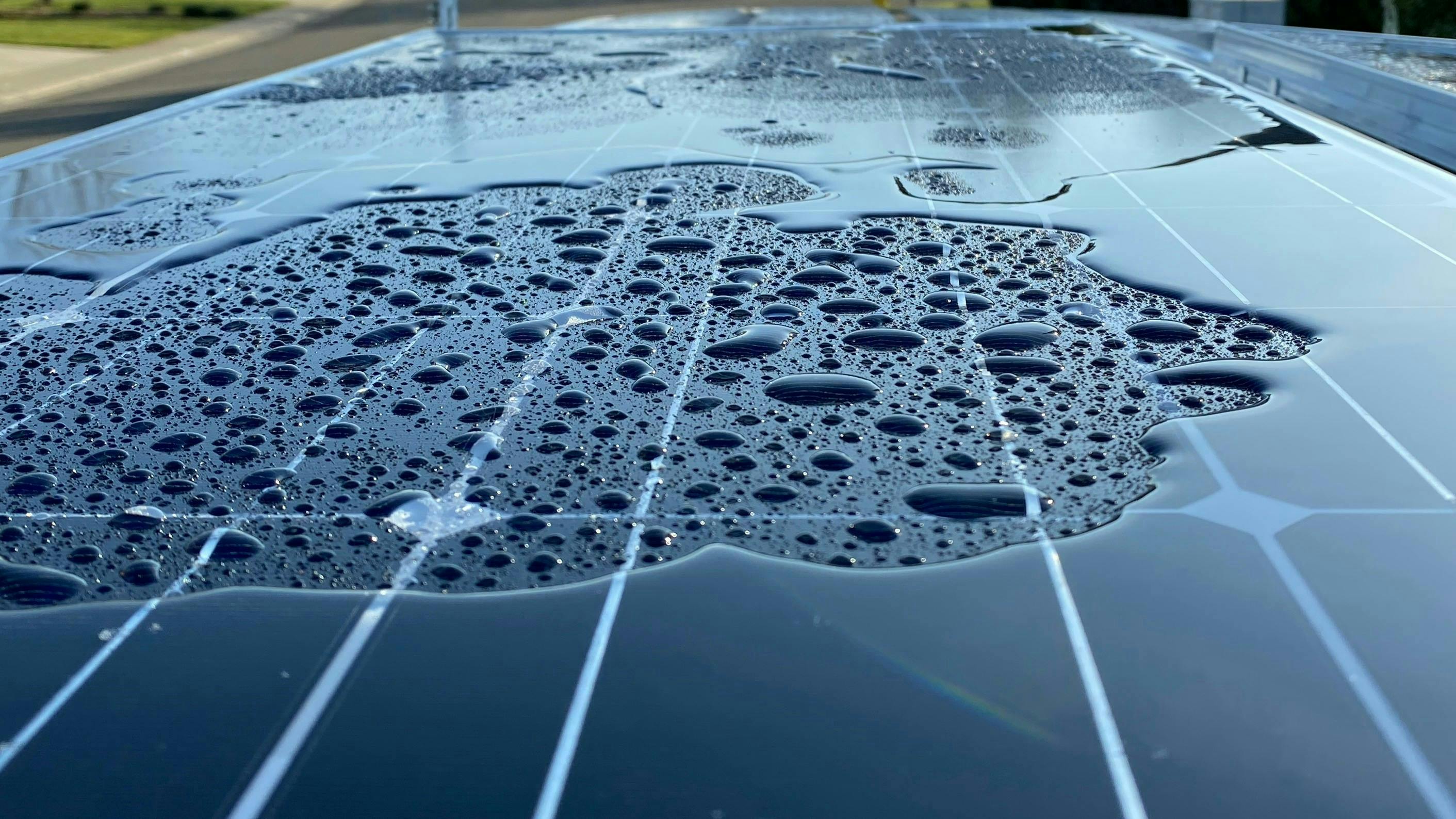
Anti-Soiling Coatings are liquid solutions applied to the surface of solar panels that modify the glass surface to reduce the adhesion of dust and other particles. Depending on the technology, coatings may have antistatic, hydrophilic, or hydrophobic properties that allow contaminants to be more easily removed by wind or rain.
But it's important to clarify what ASC does not do.
- It does not eliminate soiling completely
- It does not remove the need for cleaning altogether
- It does not offer uniform results across all locations
What it does offer is the ability to reduce the rate and severity of soiling, which translates into higher performance between cleanings, and in some cases, the opportunity to extend the intervals between them.
Two Use-Cases: Different Challenge - Same Solution
1. PV Plants with Low Cleaning Frequency (Once per Year)
In this scenario, Anti-Soiling Coatings are used not to reduce cleanings, but to improve energy output in the long gap between them. A coating like Antistatic Solar Armor 2.0 (ASA 2.0) can help delay re-soiling and keep panels cleaner for longer. That means more kWh generated, even when the cleaning schedule remains unchanged.
2. PV Plants with High Cleaning Frequency (2+ Times per Year)
In dusty, industrial or agricultural regions where cleaning is frequent, the goal is often to reduce O&M costs without sacrificing performance. By slowing the soiling rate, coatings can extend the time between cleanings, decreasing labour, water, and equipment use. When performance degradation is monitored closely, operators can shift from fixed schedules to condition-based cleaning, optimizing efficiency and cost.
Why Soiling Mitigation Is Not One-Size-Fits-All
Several factors determine how much value an ASC will deliver:
- Soiling rate and type: Dust vs. pollen vs. metal oxides
- Climate conditions: Wind, rainfall, humidity, and temperature
- Module tilt and installation layout
- Cleaning method availability and cost
- Local water restrictions and environmental regulations
Soiling mitigation is not an exact science. It requires monitoring, customized planning, and validation over time. Coatings are most effective when integrated into an O&M strategy that includes performance tracking, soiling measurement (e.g. soiling stations), and periodic reevaluation.
What the Data Shows
Field results from ChemiTek’s partners and customers around the world confirm that ASC consistently:
- Improves performance ratio (PR) between cleanings
- Reduces accumulation of soiling and contaminants
- Lowers the rate of performance degradation in dry or windy conditions
- Supports water savings when cleaning is reduced or optimized
In a Scatec case study, Solar Wash Protect was applied to a 60 MW power plant in Honduras called Agua Fria, which has high levels of dust and minimal rainfall. Over the course of a month, the modules treated with SWP produced 2.3% more energy compared to the modules cleaned with water alone.
A Smarter Way to Protect Your Energy Output
The solar industry is moving toward smarter, more data-driven O&M strategies. Anti-Soiling Coatings are a powerful tool in that evolution—but they are not a universal fix. They work best when aligned with local conditions, integrated into broader maintenance plans, and regularly evaluated for impact.
Whether you're operating a large-scale desert plant with monthly cleaning cycles, or a remote installation cleaned once a year, coatings can unlock additional value by keeping your panels cleaner, longer.
"The most efficient PV Asset Managers don’t just clean — they protect."